

Business Succession Planning Advice for Australian SMEs
By Bé Verwey, Founder and Director, Ernstver Consulting
Running a successful business requires years of commitment, strategic decision-making and continuous improvement. Yet many Australian business owners spend far more time building their business than planning what will happen when they eventually step away. Whether retirement is decades away or just around the corner, succession planning is one of the most important investments you can make for your company's future.
Small business succession planning is more than choosing who will take over. It involves preparing your business to continue operating successfully while protecting its value, employees, customers and reputation. A well-developed succession plan reduces uncertainty, minimises disruptions and creates confidence among everyone connected to your business.
At Ernstver Consulting, we help business owners prepare for long-term success through strategic business coaching and mentoring. By combining practical planning with leadership development, we help businesses build stronger foundations that support sustainable growth and successful transitions.
Why Succession Planning Matters for Australian Small Businesses
Many small businesses rely heavily on the owner's knowledge, relationships and decision-making. While this works during daily operations, it creates significant risk if the owner unexpectedly retires, becomes ill or decides to sell.
Without a succession plan, businesses often experience operational disruptions, declining profitability and reduced business value. Customers may lose confidence, employees may become uncertain about their future, and potential buyers may see increased risk.
On the other hand, businesses with a structured succession strategy are often more attractive to investors and purchasers because they demonstrate stability, continuity and strong management practices.
Planning early gives owners greater control over how their business evolves while ensuring years of hard work continue to deliver value.
What Is Small Business Succession Planning?

Succession planning is the structured process of preparing a business for a change in ownership or leadership. This may involve transferring the business to family members, promoting internal leaders, selling to an external buyer or establishing employee ownership arrangements.
A comprehensive succession plan typically addresses:
- Leadership transition
- Ownership transfer
- Financial planning
- Legal and tax considerations
- Business valuation
- Staff retention
- Customer communication
- Operational continuity
Rather than being a single document, succession planning is an ongoing process that evolves alongside the business.
When Should You Start Succession Planning?
One of the biggest misconceptions is that succession planning only becomes relevant when retirement is approaching. In reality, the best succession plans begin years before the transition occurs.
Starting early provides time to:
Develop future leaders within the business, improve systems and documentation, strengthen financial performance, increase business value and address any operational weaknesses before ownership changes.
Unexpected life events can happen at any stage, making early planning an important risk management strategy rather than simply a retirement exercise.
Why Succession Planning Is Urgent for Australian Small Businesses Right Now
A recent 2026 VistaPrint and Pureprofile study on business marketing trends found that close to one in three Australian small business owners plan to retire within five years, yet only 16 per cent have a documented succession plan. Nearly half of all owners considering an exit have no plan at all.
For most of these owners, the business is their retirement fund, so leaving without a plan is not just a management risk. It is a personal financial risk. Add rising insolvency numbers and an ageing owner population, and it becomes clear why succession planning has moved from a nice-to-have to an urgent priority for thousands of Australian businesses.
The Key Components of an Effective Succession Plan

Define Your Long-Term Goals
Every business owner's exit strategy is different. Some intend to pass the business to family members. Others may wish to sell to employees, management teams or external buyers. Some owners want to remain involved as advisers after stepping away from daily operations.
Understanding your personal and financial goals helps shape every other decision throughout the succession planning process.
Build a Business That Can Operate Without You
One of the greatest indicators of business value is its ability to function independently of the owner. Businesses that rely entirely on one individual often struggle during ownership transitions.
This means documenting procedures, developing leadership capability, improving internal systems and empowering managers to make decisions confidently. A business that operates smoothly without constant owner involvement is significantly easier to transfer or sell.
Understand the Financial Position of Your Business
Potential buyers and successors expect clear financial records and reliable reporting. Business owners should ensure:
Financial statements are accurate and current, cash flow is well managed, business debts are controlled, profit margins are sustainable and financial systems support informed decision-making.
Improving financial performance before succession often increases business valuation while making ownership transfer significantly smoother.
Identify and Develop Future Leaders

If the business will remain within the organisation, leadership development becomes essential. Future leaders require more than technical knowledge. They also need decision-making skills, financial understanding, communication abilities and confidence to manage people effectively.
Many successful succession plans involve several years of mentoring before leadership responsibilities are fully transferred. This is where professional business growth coaching provides substantial value by helping future leaders develop the practical capabilities required for long-term success.
Document Critical Business Knowledge
Many owners hold years of experience that exists only in their own memory. This knowledge may include customer relationships, supplier negotiations, pricing strategies, operational procedures and problem-solving methods.
Documenting these processes reduces dependency on individuals while making it easier for successors to continue operating successfully. Well-documented systems also improve efficiency long before succession takes place.
Prepare Employees for Change
Employees often feel uncertain when ownership changes. Clear communication helps maintain confidence while reducing unnecessary anxiety. Involving key employees appropriately throughout the planning process also encourages engagement and improves retention during periods of transition.
Strong workplace culture can become one of the most valuable assets transferred to future leadership.
Consider Legal and Tax Requirements
Business succession involves numerous legal and financial considerations. Depending on the ownership structure, succession planning may require updates to shareholder agreements, partnership agreements, trusts, wills or business structures.
Professional legal and accounting advice ensures compliance while helping owners minimise unnecessary tax implications during ownership transfers.
Common Succession Planning Mistakes Small Business Owners Make

The most common mistake is simply starting too late. Many owners intend to build a plan in a few years, then a health scare, a partnership dispute or an unexpected buyer enquiry forces the issue before anything has been prepared. A close second is treating succession as a legal exercise rather than a leadership one, so the paperwork exists, but no one has actually been trained to run the business.
Owners also frequently overestimate what their business is worth, largely because they have never had it properly valued, and they underestimate how much of that value is tied up in their own personal relationships and reputation rather than in the business itself. Perhaps the quietest mistake of all is simply not talking about it.
Plenty of owners have a rough plan in their head that they have never shared with family, staff or an adviser, which almost guarantees confusion and conflict when the time actually comes.
The Role of Business Coaching and Mentoring in Succession Planning
This is where business coaching and mentoring become one of the most practical tools available to an owner preparing for succession. A coach works alongside you to build the systems, leadership bench and financial clarity that make a handover possible in the first place.
Business growth coaching helps lift the value of the business ahead of a sale or transfer, since buyers and successors alike pay more for a business with strong processes, diversified revenue and a team that can operate without constant owner input. Mentoring plays a different but equally important role. It prepares the person who will actually take over, whether that is a family member, a business partner or a senior employee, by building their confidence, decision-making and leadership presence well before the handover date arrives.
Owners who bring in a coach early, often two to three years before they intend to step back, tend to have far more options at exit time. They can choose a successor rather than settle for whoever happens to be available, and they generally achieve a stronger sale price because the business no longer depends entirely on them to function.
Why Choose Ernstver Consulting?
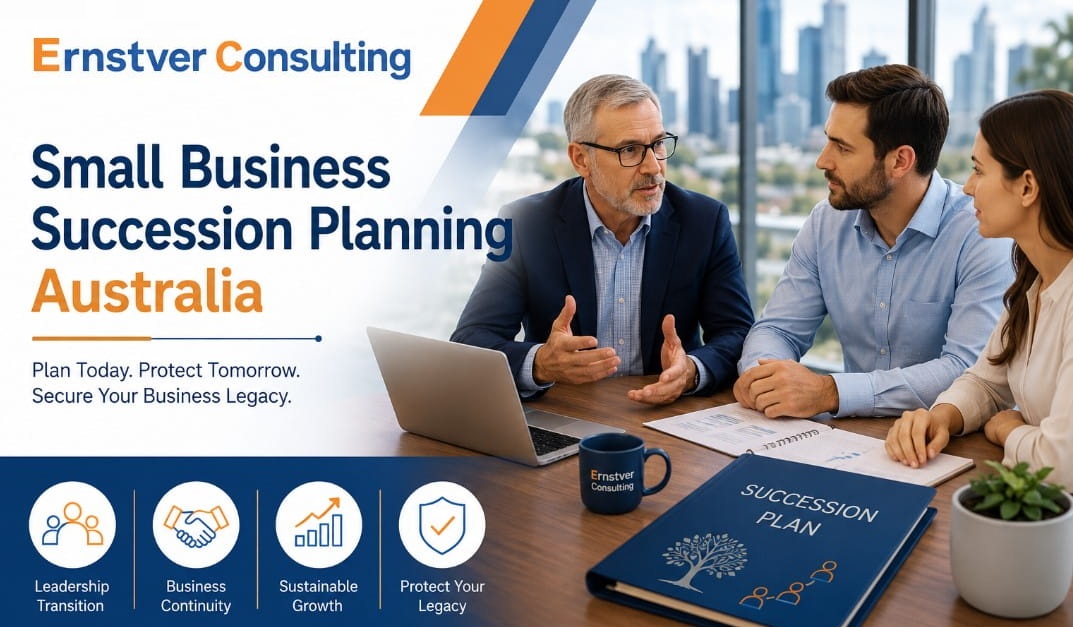
At Ernstver Consulting, we understand that every business has unique goals, challenges and opportunities. Our practical coaching approach helps business owners build stronger businesses today while preparing confidently for tomorrow.
Whether your succession timeline is two years or twenty years away, strategic planning combined with effective business coaching and mentoring creates stronger outcomes for business owners, employees and future leaders alike.
We work alongside Australian businesses to improve leadership capability, strengthen operational performance and create practical strategies that support long-term business continuity.
Frequently Asked Questions
Can succession planning increase business value?
Yes. Businesses with documented systems, strong leadership teams and structured succession plans are generally more attractive to buyers and investors.
Is succession planning only for family businesses?
No. Succession planning benefits businesses of all sizes, regardless of whether ownership will transfer to family members, employees, management teams or external buyers.
When should I start succession planning for my small business?
Ideally, two to five years before you intend to step back. This gives enough time to develop a successor, address any gaps in the business and improve its value before a sale or handover. Many owners wait until retirement feels close, which leaves far fewer options and often results in a rushed, lower-value exit.
What is the difference between a succession plan and an exit strategy?
An exit strategy usually focuses on how and when you leave, such as a sale, merger, or wind-down. A succession plan is broader. It covers who will lead the business, how operations continue without disruption and how ownership actually transfers, whether that is to family, a partner, staff or an external buyer.
Do I need a succession plan if I am not planning to retire soon?
Yes. Illness, injury and unexpected life events do not wait for a convenient time. A basic plan that covers who could step in tomorrow protects your business, your staff and your family, regardless of how far away retirement feels.
How can business coaching and mentoring help with succession?
A coach helps you build the systems and leadership depth that make a handover realistic, while a mentor prepares your chosen successor for the responsibility ahead of time. Together, they reduce how much the business relies on you personally, which tends to increase both its value and its chances of a smooth transition.
What happens if I do not have a succession plan in place?
Without a plan, an unexpected exit, whether through illness, dispute or an unplanned sale, often leaves the business scrambling, staff uncertain, and family relationships strained. Value can be lost quickly when a business has no clear leadership path or documented process for continuing operations.
Ready to Build a Succession Plan That Actually Works?
Succession planning is not something to leave until the timing feels urgent. The owners who protect the value of their business and their own future are the ones who start the conversation early. Ernstver Consulting helps Melbourne business owners build practical, structured succession plans through experienced business coaching and mentoring. Book a free consultation with our team today and take the first step toward a business and a future that does not depend entirely on you.


